
Best Refrigerant for Car Ac: Top Cooling Choices Reviewed
A weak car A/C rarely starts with the compressor; it usually starts with the wrong refrigerant choice, the wrong amount, or a quick top-off that ignores a slow leak. Pick the right charge and you get cold air fast. Pick wrong, and you can chase lukewarm vents for weeks.
I’m the Shop-Manual Realist: the person who reads the A/C service sticker before touching a can. Car A/C refrigerant choices matter because they affect vent temps, system pressures, and long-term reliability. The tricky part is that “more” refrigerant isn’t better, and “compatible” isn’t the same as “correct.” Below, we focused on R134a-style recharge setups and the tools that make charging safer, cleaner, and less guessy.
How we kept the charge honest
We evaluated these products the same way we handle a driveway A/C rehab: confirm the vehicle’s refrigerant type from the under-hood label, then check connection compatibility, valve style (self-sealing vs puncture), and how controllable the fill process feels. We prioritized clear pressure feedback (gauges/hose length), practical storage of leftover refrigerant, and safety realities (flammability class, handling warnings). We also compared pack sizing to common “top-off vs full service” needs so buyers don’t overbuy or underbuy.
ZeroR AC Refrigerant R134a Replacement 12 Cans

Bulk refrigerant is for people who don’t want one hot day to turn into an ongoing project. This 12-pack of ZeroR targets R134a systems but uses a natural hydrocarbon blend instead of traditional R134a. The first thing that stands out is the claim of higher “equivalent” performance per 6oz can, which changes how you plan a recharge. Thread compatibility with R134a-style recharge equipment keeps the install familiar, but you still need to treat it like a different refrigerant.
Pros
- Big 12-pack covers multiple vehicles
- R134a-threaded cans fit common taps
- Smaller cans are easier to meter
- Hydrocarbon blend can cool efficiently
- Good option for repeated top-offs
Cons
- Flammable refrigerant requires extra care
- Equivalent-oz claims can confuse dosing
In practice, the 6oz cans are convenient because you can add in smaller steps instead of dumping a big can and overshooting pressures. That matters when vent temps improve quickly and you’re tempted to keep filling. With a hydrocarbon blend, careful handling and ventilation are non-negotiable, and you’ll want a proper gauge setup to avoid guessing. For a household with multiple older R134a vehicles, the pack size reduces last-minute store runs.
Buy this if you maintain several R134a vehicles, or you’re the go-to friend for A/C fixes and want consistent supply. It also makes sense if you prefer smaller can increments for more control. Skip it if you only need a one-time top-off, if you’re uncomfortable handling a flammable refrigerant, or if you don’t have a reliable way to monitor system pressures while charging.
ZeroR AC Refrigerant R134a Replacement 6 Cans
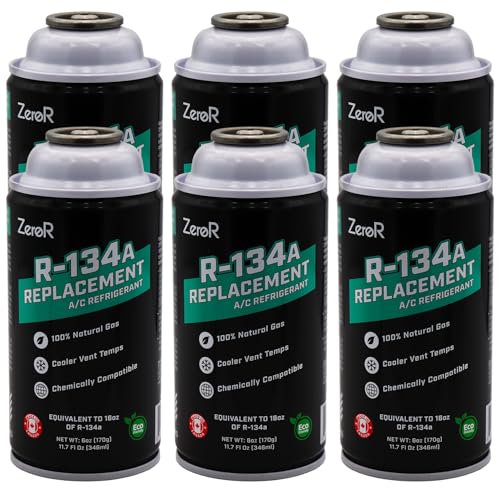
Not everyone needs a case of cans rolling around the garage. The 6-pack version of ZeroR hits a sweet spot: enough refrigerant for a couple of services, without committing to bulk storage. Like the larger pack, it’s a natural hydrocarbon refrigerant marketed as an R134a replacement with R134a-compatible threads. The headline “6oz equals 16oz” idea can be helpful for planning, but it also means you must slow down and charge by pressure, not by guesswork.
Pros
- More manageable pack for DIYers
- R134a-compatible threads simplify setup
- Smaller cans help avoid overfill
- Eco-leaning hydrocarbon alternative
- Enough quantity for two cars
Cons
- Needs careful pressure monitoring
- Flammability adds handling restrictions
For a typical driveway recharge, this size feels realistic: you can address a low system, then keep a couple cans for future maintenance if there’s a minor seep. The cans should connect to common R134a recharge hoses, so the workflow stays familiar. The key is treating “equivalent performance” as a planning note, not a measuring tool. A/C systems are picky; charging slowly while watching pressures is what keeps cooling strong and compressors happy.
Choose the 6-pack if you want a practical middle ground: enough for a couple of R134a vehicles or a follow-up charge after leak repair. Avoid it if you expect a single-can, super-simple experience without gauges, or if local rules or personal comfort steer you away from flammable refrigerants. For cautious DIYers who measure as they go, it’s a sensible quantity.
ZeroR AC Recharge Kit R134a Replacement 2-Pack

A refrigerant can without a decent hose is like trying to cook with oven mitts full of holes. This ZeroR kit pairs two self-sealing valve cans with a long 24-inch charging hose and a gauge meant for R134a pressures. It also includes a small amount of UV dye, which is handy for spotting leaks later without turning your system into a dye experiment. First impression: it’s a more controlled, tool-forward approach than bare cans, especially for beginners.
Pros
- 24-inch hose improves access
- Gauge helps prevent blind charging
- Self-sealing valve stores leftovers
- UV dye supports leak checks
- Two-pack suits minor top-offs
Cons
- Not enough dye for big leaks
- Only for confirmed R134a systems
That extra hose length matters when the low-side port is tucked under plastic covers or near a hot radiator support. The gauge gives you at least a basic sanity check while adding refrigerant, which reduces the risk of overcharging. The self-sealing valve is a real-world win: you can stop mid-job, store the can, and come back after checking vent temps. Since the kit is mainly gas with a small dye amount, it’s geared toward topping off, not masking major problems.
Get this kit if you want a guided recharge experience with better control and less mess, especially if you’ve never charged an A/C system before. It’s also a smart pick when you suspect a small leak and want dye on board for later inspection. Pass if you need a full diagnostic setup (manifold gauges, vacuum pump) or if your vehicle isn’t clearly labeled for R134a.
ZeroR R134a Replacement Hydrocarbon Refrigerant, 3 Cans

ZeroR positions itself as an R134a-compatible replacement using a natural hydrocarbon blend. It targets DIY recharges where cooling performance is needed but users want smaller cans and potentially lower fill amounts versus conventional R134a. The key practical angle is compatibility with common R134a recharge fittings and a claimed higher effectiveness per ounce. It is best treated as a system-specific alternative, not a universal top-off, and should never be mixed with unknown refrigerants.
Pros
- R134a-style threads fit many common recharge hoses
- Strong cooling per ounce compared with standard R134a
- Smaller cans are easier to handle in tight bays
- Can reduce required charge weight for some systems
- Useful for full recharge after proper recovery and vacuum
Cons
- Flammable hydrocarbon; requires careful handling and labeling
- Not suitable for mixing with existing refrigerant
In day-to-day use, it can deliver quick vent temperature improvement when the system is properly evacuated and charged to the correct equivalent amount. The biggest real-world risk is incorrect charging by pressure alone; hydrocarbon blends can mislead DIY gauges. Best results come from recovering the old refrigerant, pulling a deep vacuum, then charging by the product’s guidance. If the system has leaks, performance gains fade quickly.
Best for experienced DIYers or techs who can verify the system is empty, leak-free, and properly evacuated before charging. Good value if you want fewer cans to reach effective cooling and you already own accurate tools. Avoid if you are unsure what refrigerant is currently in the system, if you only plan to “top off,” or if your local rules or shop policies restrict hydrocarbon refrigerants.
Orion Motor Tech AC Manifold Gauge Set, 5ft Hoses

This Orion Motor Tech manifold gauge set is a diagnostic and charging tool rather than a refrigerant, but it directly impacts how safely and accurately you service a car AC system. It’s positioned for DIYers who want real high- and low-side readings, better control than single-hose recharge kits, and compatibility across several refrigerant types via adapters. The practical benefit is troubleshooting: confirming undercharge, overcharge, restrictions, or compressor issues before wasting refrigerant.
Pros
- Reads both high and low side pressures
- Helps diagnose restrictions and weak compressor performance
- Long hoses improve reach and reduce awkward connections
- Works with multiple refrigerants using included adapters
- More control than single-hose recharge kits
Cons
- No vacuum pump included for proper evacuation
- Learning curve to avoid mischarging or venting
For regular use, it’s most helpful for confirming system condition before adding refrigerant and for monitoring pressures while charging. The hoses and couplers make connections easier, but you still need good procedure: engine speed, condenser airflow, and stable ambient conditions affect readings. Pairing it with a vacuum pump and scale produces the most consistent results. Used carelessly, it can encourage charging by pressure instead of by weight.
Buy if you want to service AC systems more correctly than with disposable gauge kits and you’re willing to learn safe manifold procedures. It’s a solid value for diagnosing leaks, restrictions, and charge issues before buying refrigerant. Skip if you only want a simple top-off tool or you’re not prepared to add a vacuum pump and scale for proper evacuate-and-recharge work.
Frequently Asked Questions
Can I use a hydrocarbon R134a replacement in my car A/C?
Only if it is legal in your area and compatible with your system. Hydrocarbon blends can be flammable and may be restricted. Many shops will not service systems filled with hydrocarbons.
Do I need gauges or a recharge kit, or can I just add refrigerant?
Use gauges to avoid overcharging and to diagnose low charge versus other faults. A hose-only kit is simpler but less precise. Best practice is measuring pressures and vent temperature together.
How do I choose between 3, 6, and 12 cans?
Choose based on how empty the system is and how many vehicles you service. Single-car top-offs usually need fewer cans. Larger packs reduce cost per can and provide backup for leaks.
Verdict: Best Refrigerant Choice for Most Drivers
Best overall: ZeroR AC Recharge Kit (2-Pack) for controlled, convenient charging with the included hose. Best budget: ZeroR R134a Replacement 3-pack if you already have tools. For frequent use, the 6- or 12-pack offers the best per-can value. If you need diagnostics and broad refrigerant support, choose the Orion Motor Tech gauge set, then refrigerant separately.